

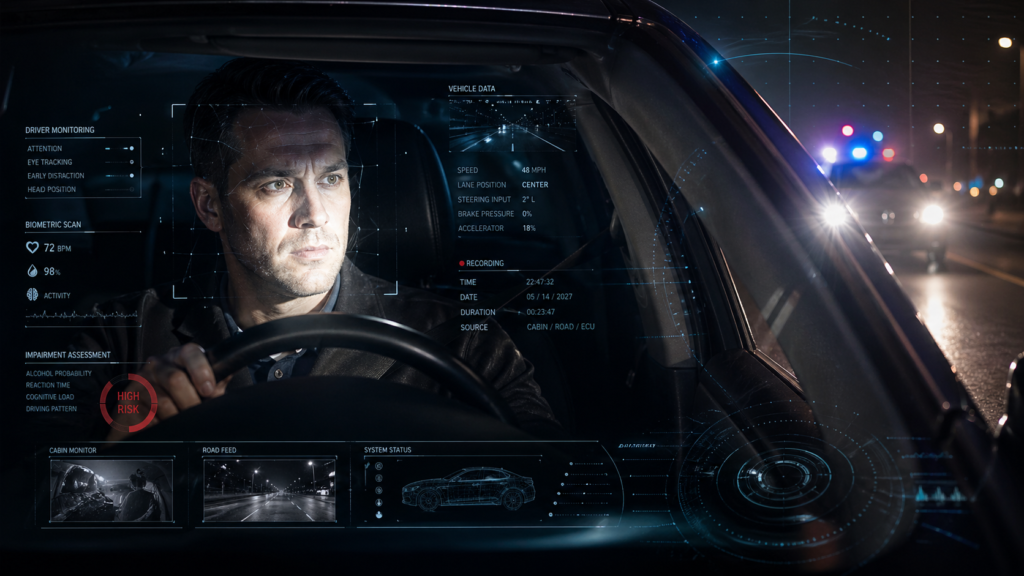
By 2027, the car in your driveway may be doing more than getting you to work, school, court, or home. It may also be monitoring how you drive, watching for signs of impairment, storing data about your behavior, and potentially creating evidence that could be reviewed after a DUI stop or serious crash.
That possibility comes from the 2021 Infrastructure Investment and Jobs Act, which directed federal regulators to develop a safety standard for advanced drunk and impaired driving prevention technology in new passenger vehicles. The goal is to prevent impaired driving before it causes harm. The concern is what happens when the technology becomes part of a legal investigation.
For Pennsylvania drivers, this issue is bigger than vehicle safety. It raises questions about privacy, accuracy, false readings, police evidence, insurance claims, and whether your own car could eventually be used to help build a case against you.
What Is the 2027 Federal Surveillance Tech Concern?
The phrase “federal surveillance tech” may sound dramatic, but the concern comes from a real shift in vehicle safety policy. Federal regulators have been studying technology that could detect impaired driving passively, meaning the driver may not need to blow into a device or actively perform a test.
The advanced impaired driving prevention technology rulemaking process is focused on how new vehicles may eventually identify unsafe operation. That could include systems that detect alcohol impairment, monitor driver behavior, track driver attention, or evaluate whether someone appears capable of safely operating the vehicle.
Supporters see this as a lifesaving tool. If a vehicle can prevent an impaired person from driving, it could help reduce drunk driving crashes and serious injuries.
But the public concern is not only about stopping drunk drivers. The concern is also about how much data cars will collect, who will control that data, and how that information could be used after a traffic stop, crash, insurance claim, or criminal charge.
Could Your Car Become Part of a DUI Investigation?
In a traditional Pennsylvania DUI case, the evidence usually starts with what a police officer claims to have observed. That may include weaving, speeding, delayed reaction time, an unsafe turn, the smell of alcohol, slurred speech, field sobriety testing, breath testing, blood testing, dash camera footage, body camera footage, and police reports.
In the future, vehicle data may add another layer.
A prosecutor may want to know whether the car recorded unusual steering, lane movement, sudden braking, speed changes, driver attention alerts, or impairment warnings. A defense attorney may need to examine whether the system was accurate, whether the data was preserved correctly, and whether the information actually proves impairment under Pennsylvania law.
That distinction matters. A vehicle may record unusual driving, but unusual driving is not the same thing as being guilty of DUI.
A driver may swerve because of a pothole. A person may brake late because another vehicle stopped suddenly. Someone may drift within a lane because of road conditions, fatigue, distraction, a medical issue, or a momentary lapse in attention. Vehicle data may show that something happened, but it may not explain why it happened.
That is where a DUI attorney’s role becomes important. Technology can create evidence, but it does not automatically create context.
Smart Cars Can Still Make Mistakes
One of the biggest legal concerns with driver-monitoring technology is the risk of false readings.
A system designed to detect impairment may not always know the difference between intoxication and fatigue. It may not understand a medical condition. It may misread eye movement, steering behavior, reaction time, or lane position. It may flag conduct that has an innocent explanation.
The National Highway Traffic Safety Administration has acknowledged that developing this type of technology requires careful rulemaking and performance standards. NHTSA’s recent reports have also made clear that the technology still faces major challenges involving accuracy, reliability, and real-world use.
That is important because even a small error rate can matter when applied to millions of vehicles and millions of drivers.
For a Pennsylvania driver, a false reading could create serious consequences. It could lead to confusion during a traffic stop, become part of a police report, influence an insurance investigation, or be used to suggest impairment when the full facts tell a different story.
The Privacy Issue Is Not Going Away
If vehicles begin monitoring impairment, driver attention, eye movement, steering behavior, braking patterns, speed, and other driving activity, drivers will naturally ask who gets access to that information.
Could police request it after a DUI stop? Could prosecutors use it in court? Could insurance companies review it after a crash? Could vehicle manufacturers store it? Could the data be misinterpreted by someone who does not understand the limits of the technology?
These questions are not anti-safety. They are basic privacy and due process questions.
A vehicle safety system may be designed to prevent crashes, but once data exists, it can become valuable to many different parties. That includes law enforcement, insurance companies, civil attorneys, and potentially others involved in a legal dispute.
For Pennsylvania drivers, the issue is not only whether this technology will make roads safer. The issue is whether the data will be used fairly.
What Happens After a Crash?
The same technology that may affect DUI cases may also affect accident investigations.
If a serious crash happens, vehicle data may help answer important questions. How fast was the car going? Did the driver brake? Did the vehicle issue a warning? Was a safety system active? Did the driver ignore an alert? Did the car detect signs of unsafe operation before impact?
In some cases, that information may help injured victims prove what happened. In other cases, it may create disputes over fault, causation, and whether the data is being interpreted correctly.
Insurance companies may also try to use vehicle data in ways that benefit them. They may argue that an injured person’s account does not match the data. They may dispute the seriousness of the crash. They may use technical information to reduce the value of a claim.
That is why serious crash cases often require careful evidence preservation and legal review. Vehicle data can be useful, but it should not be accepted without context.
For those dealing with injuries after a collision, speaking with experienced personal injury attorneys can help accident victims understand what evidence may matter and what steps may be available after a crash.
Why This Matters in Delaware County, PA
Drivers in Media, Springfield, Upper Darby, Ridley, Chester, Havertown, and throughout Delaware County already face busy roads, aggressive driving, distracted driving, impaired driving, and serious accident risks. If federal vehicle safety requirements bring more monitoring technology into new cars, local DUI cases and crash investigations may become more technical.
A traffic stop may no longer be limited to what the officer says happened. A crash claim may no longer be limited to the police report and witness statements. A vehicle’s own data may become part of the story.
That can help reveal the truth, but it can also create new problems when the technology is misunderstood, incomplete, or treated as more reliable than it actually is.
If you are accused of DUI, the question is not simply whether data exists. The question is whether that data is accurate, relevant, lawfully obtained, and properly interpreted.
Did You Know?
Pennsylvania’s Accelerated Rehabilitative Disposition program, commonly known as ARD, may offer certain first-time DUI offenders an alternative to traditional sentencing. ARD can involve alcohol highway safety school, treatment, community service, supervision, and other court requirements. If completed successfully, the DUI charge may be dismissed, and the person may be able to seek expungement.
However, ARD eligibility is not automatic. The facts of the case matter, including prior record, blood alcohol level, accident details, injuries, and other circumstances.
The Law Office of Steven F. O’Meara helps people facing DUI charges in Delaware County, PA understand their rights, evaluate ARD eligibility, and navigate the legal process with experienced guidance.
Speak With a Delaware County DUI Attorney
By 2027, federal surveillance tech and impaired-driving detection systems could become a much bigger part of the national conversation around vehicle safety. These systems may help prevent crashes, but they may also raise new questions about privacy, false readings, DUI evidence, and how vehicle data is used after a traffic stop or accident.
If you were charged with DUI in Delaware County, PA, it is important to understand your options before making decisions that could affect your license, record, insurance, job, and future.
The Law Office of Steven F. O’Meara represents individuals facing DUI charges and other criminal matters in Media, PA and throughout Delaware County. Contact the firm to discuss your case and learn what steps may be available to protect your rights.